#
Project
Investment · stage
1

Abidjan-Ouagadougou-Niamey-Cotonou-Lomé Regional Rail Loop
T.RL.26.04
The Abidjan-Ouagadougou-Niamey-Cotonou-Lomé Railway Loop is a proposed 2,928 km regional railway infrastructure project connecting five West African countries: Côte d'Ivoire, Burkina Faso, Niger, Benin and Togo. The railway corridor will…
2

Praia-Dakar-Abidjan Multimodal Transport Corridor
T.RD.26.02
The programme is intended to establish an integrated economic and transport corridor from Praia in Cabo Verde to Dakar and onward to Abidjan through the coastal states of western Africa.…
3
Mombasa-Nairobi-Malaba-Kampala-Kigali Standard Gauge Railway with Malaba-Nimule-Juba Spur
T.RL.26.03
The Northern Corridor Standard Gauge Railway is intended to create an interoperable regional railway from the Indian Ocean port of Mombasa to Uganda and Rwanda, with an additional link to…
4

Abidjan-Lagos Corridor Highway Development Project
T.RD.26.03
The project is being implemented in line with the decision of the Presidents of the five countries along the Abidjan-Lagos Corridor in February 2014, to construct a 6-Lane (2x3) dual-carriage…
5

Grand INGA Phase 1
E.30.16
The project proposes electricity interconnections from the Grand Inga hydropower station through a northern axis, southern axes using eastern and western corridors, and a western axis. The generation and transmission…
6
LAPSSET Railway Project
T.RL.26.02
The LAPSSET Railway Project forms the railway component of the Lamu Port-South Sudan-Ethiopia Transport Corridor. Its approved purpose is to create a new regional rail connection from the Indian Ocean…
7
Establishment of a Navigational Line between Lake Victoria and the Mediterranean Sea - Feasibility Study Phase 2 (VICMED)
T.IW.26.04
The VICMED initiative proposes an integrated navigation and multimodal transport corridor from Lake Victoria to the Mediterranean Sea. It is intended to connect Nile Basin countries through river, lake and…
8
Libyan Alternative Freeway
T.RD.26.07
The project proposes an inland alternative freeway running east-west across Libya for approximately 1,750 km. It is intended to improve national and regional route redundancy, relieve pressure on coastal connections,…
9
3,050 MW Mambilla Hydroelectric Power Project
E.30.08
The project will develop a 3.05 GW hydroelectric complex near Kakara Village on the Mambilla Plateau in Taraba State. The approved PAP II concept includes four dams on the Donga…
10
Mtwara-Mbamba Bay Standard Gauge Railway with Spurs to Liganga and Mchuchuma
T.RL.26.01
The project will connect Mtwara Port with Mbamba Bay through southern Tanzania and provide branch lines to the Mchuchuma coal and Liganga iron-ore deposits. The PAP II concept covers approximately…
11

Trans-Saharan Optic Fibre Broadband Project
I.02.30.01
The Trans-Saharan Optic Fibre Broadband Project (also known as the Dorsale Transsaharienne a Fibre Optique, DTS) is a multinational terrestrial fiber optic backbone connecting six African countries: Algeria, Niger, Nigeria,…
12
Rehabilitation, Modernisation and Service Improvement of the Trans-Maghreb Railway
T.RL.26.05
The project is intended to restore and modernise a continuous railway corridor between Morocco, Algeria and Tunisia. The approved first-phase scope includes modernisation of the Fez-Oujda line, rehabilitation of the…
13
INGA 3 Transmission Interconnector
E.30.15
The project covers feasibility studies for the design, development, operation and maintenance of a high-voltage direct-current transmission scheme associated with the Inga 3 Low Head Project. The studies will cover…
14
Construction of a Bridge over the Oubangui River and Development of the Bangui-Kisangani-Kampala and Kisangani-Bujumbura Corridors
T.BD.20.02
The Oubangui River crossing between Bangui and Zongo is a missing physical link between the Central African Republic and the Democratic Republic of Congo. The project is designed as more…
15
Lesotho Highlands Water Project (LHWP) Phase II
W.04.01
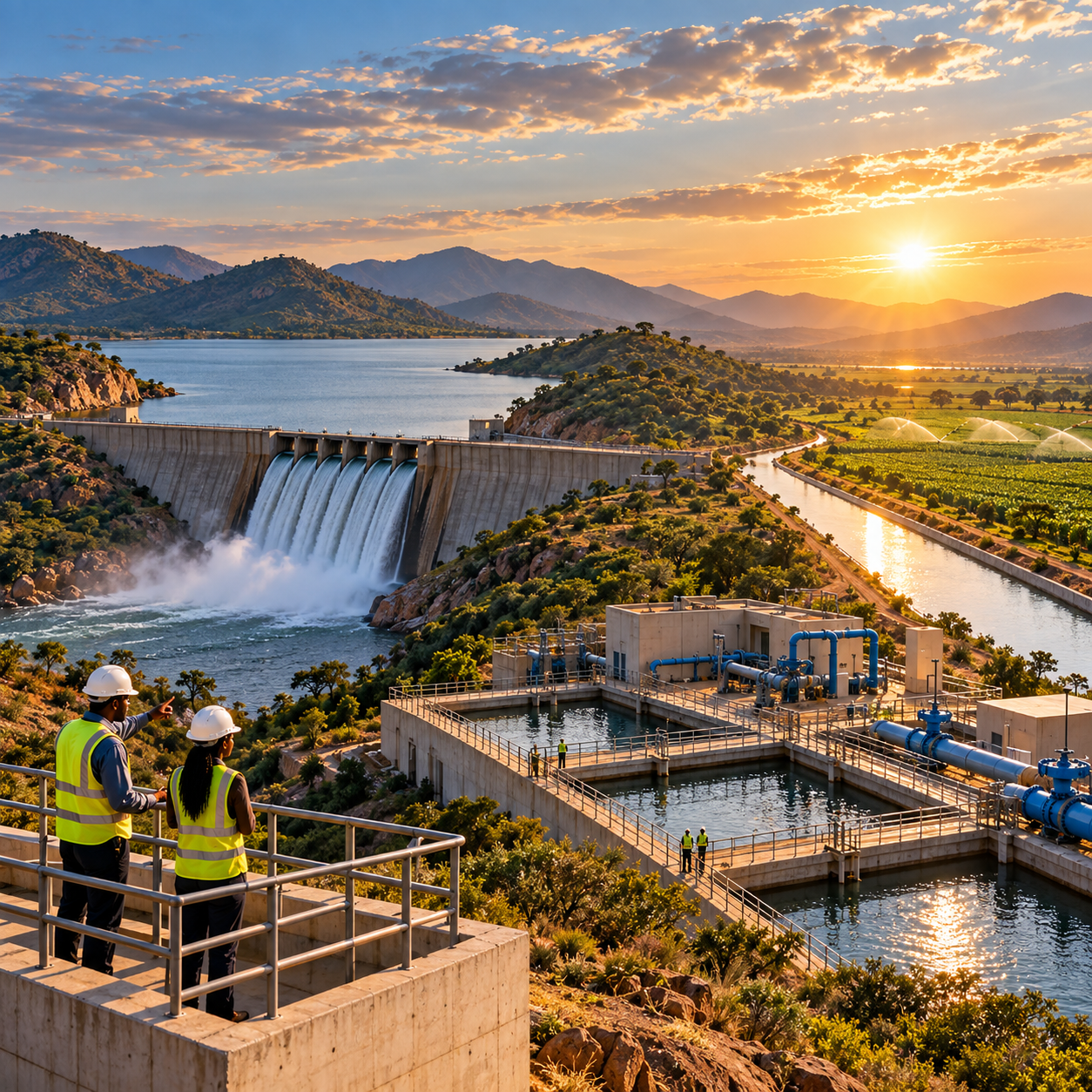
The Lesotho Highlands Water Project (LHWP) Phase II is a multi-billion Maloti/Rand bi-national infrastructure project between the Governments of the Kingdom of Lesotho and the Republic of South Africa, established…
16
LAPSSET Crude Oil Pipeline
E.30.03
The project proposes a crude-oil pipeline from the South Sudan oil fields and the South Lokichar basin in Kenya to Lamu Port. Crude oil will be received at a tank…
17
Lesotho-Botswana Water Transfer Project
W.30.04
The project will construct a multipurpose dam on the Makhaleng River in Lesotho, associated hydropower facilities and a water-conveyance system of approximately 700 km through South Africa to Botswana. Current…
18
Egypt and Sudan Electrical Grid as the First Stage of the Continental Electrical Interconnection
E.30.14
The first stage will connect Egypt and Sudan along the Cairo-Cape Town road corridor through two high-voltage circuits. The PP2 concept considers 1,000 kV HVDC or a combination of 800…
19
Development of the Chollet Hydroelectric Site and Associated Transmission Lines
E.30.10
The PP2 project comprises development of a hydroelectric power station with an installed capacity of 600 MW and construction of associated transmission lines to supply localities in northern Republic of…
20
Continental Africa Water Investment Support Programme (AIP)
W.30.01
AIP provides an enabling and project-preparation framework for priority transboundary and regional water investments submitted by African member states. It supports integrated water, health, energy and food-security projects; strengthens institutional…
21
Development of the Booue and Tsengue-Leledi Hydroelectric Sites and Associated Transmission Lines
E.30.09
At Booué, the project will develop an intake dam, headrace canal and a power station equipped with five Kaplan units with total installed capacity of 411 MW. At Tsengué-Lélédi, it…
22
Baynes Hydropower Project
E.30.11
The project will construct a hydropower dam and power station on the Cunene River at the Angola-Namibia border, downstream of the Epupa Falls. The station is planned with a capacity…
23
Bou Salem-Algerian Border Motorway
T.RD.26.04
The project will construct approximately 80 km of dual-carriage motorway between Bou Salem and the Tunisian-Algerian border. Together with the Oujda-Algerian-border link in Morocco, it will close the principal missing…
24
Construction of 287 MW Ruzizi IV Hydropower Project
E.30.02
The power plant will be located on the Ruzizi River, which forms the common border between Rwanda and the Democratic Republic of Congo, approximately five kilometres west of Bugarama in…
25
Eastern Africa Green Power Transmission Network Project 6 - Guba (Ethiopia)-Khartoum (Sudan)
E.30.06
The project will develop a cross-border high-voltage alternating-current transmission line from Guba in Ethiopia to Khartoum in Sudan. It is one of the interconnections proposed under the Eastern Africa Green…
26
Louga Hydroelectric Power Plants 1 and 2 (246 MW)
E.30.12
Louga 1 will include a reservoir, a 1,683 m dam, three bulb-type generating units with total capacity of 126 MW, a spillway and tailrace canal. Louga 2 will include a…
27
Dawa River Multi-purpose Dam
W.30.06
The project proposes a multipurpose dam on the Dawa River approximately 20 km upstream of Rhamu Dimtu in Kenya and near Boni in Ethiopia. Current PIDA specifications indicate an estimated…
28
Luapula Hydropower Project
E.30.04
The Democratic Republic of Congo and Zambia signed an intergovernmental memorandum of understanding on 9 July 2015 for the joint development of generation projects in the Luapula River Basin and…
29
Transborder Submarine Fiber PoPs, Regional Smart Hub Facility and Data Centre
I.02.30.05
The Transborder Submarine Fiber PoPs, Regional Smart Hub Facility and Data Centre is a multi-country ICT infrastructure project under the PIDA Priority Action Plan 2 (PAP 2) 2021-2030. The project…
30
Noordoewer/Vioolsdrift Dam
W.30.09
The project proposes a joint dam on the Lower Orange River near Noordoewer in Namibia and Vioolsdrift in South Africa. The feasibility process has examined alternative sites and sizes for…
31
Modernisation of RN01 between Ghardaia and Tamanrasset
T.RD.26.08
The project covers modernisation of RN01 between Ghardaia and Tamanrasset, a central Algerian section of the Trans-Saharan Highway. The intended works include capacity, pavement, alignment, safety and service improvements needed…
32
Ntem River Bridge on the Kribi-Campo-Bata Transnational Road
T.BR.26.01
The Ntem River Bridge is intended to close a major missing link between Cameroon and Equatorial Guinea on the Kribi-Campo-Bata road corridor. It will support a continuous regional route connecting…
33
Development of the BAC and LOTEMO Hydroelectric Sites on the Lobaye River, and Related Works in CAR
E.30.17
BAC and LOTEMO have similar hydrological and topographical conditions in a narrow rocky valley of the Lobaye River. Each run-of-river site will use a concrete overflow dam with a powerhouse…
34
Masaka - Mwanza Transmission Line Project
E.30.01
The approved project comprises a 98 km transmission line operating at 220 kV. It was identified as a least-cost transmission investment in the Tanzania Power System Master Plan and the…
35
Egypt and Libya Regional Electrical Interconnection as the First Stage of Completion of the Regional Electrical Interconnection of the North African Region
E.30.13
The project comprises an alternating-current transmission line of about 165 km between Saloum and Tobruk. It will connect the Egyptian 500 kV system with the Libyan 400 kV system through…
36
Akagera River Transport
T.IW.26.02
The project is intended to create an inland-water transport connection from Lake Victoria through the Kagera/Akagera River to Kagitumba in eastern Rwanda. Its approximately 260 km scope may require river…
37
El Fasher-Kabkabiya-El Geneina-Adri Road
T.RD.26.06
The project is intended to provide a paved regional road from El Fasher through Kabkabiya and El Geneina to Adri at the Chad border. It covers about 328 km of…
38
WAPP Regional Solar Power Park Project in Mali
E.30.18
The project is part of the ECOWAS Master Plan's renewable-energy subprogramme for an integrated and efficient West African electricity system. It will develop a scalable, multiphase and multi-site solar power…
39
Zimbabwe Zambia Botswana Namibia (ZIZABONA) Interconnector Project
E.30.05
The project will construct a set of 330 kV transmission links across Zimbabwe, Zambia, Botswana and Namibia. The principal sections are the Hwange-Livingstone/Mukuni connection between Zimbabwe and Zambia, the Victoria…
40
Noumbiel Multipurpose Dam
W.30.05
The Noumbiel project is a transboundary multipurpose dam proposed on the Mouhoun, close to the confluence with the Koulbi and the Burkina Faso-Ghana border. The approved PAP II submission describes…
41
Integration of Electrical Networks between Inga-Cabinda and Pointe Noire
E.30.07
The project consists of completing the environmental and social impact assessment, updating the tender documents and carrying out the transmission works required to connect Inga, Cabinda and Pointe-Noire. The infrastructure…
42
Fes-Oujda Motorway Link to the Algerian East-West Motorway
T.RD.26.01
The project will construct an approximately 24 km dual-carriage motorway from the terminal part of the Fes-Oujda motorway to the Moroccan-Algerian border, where it is intended to connect with Algeria's…
43
Angololo Multipurpose Water Resources Development Project
W.30.02
The project will construct a dam of about 30 metres on the Malaba River at the Kenya-Uganda border, creating a reservoir of roughly 31 million cubic metres. The scheme is…
44
Construction of Amilcar Cabral Submarine Cable System
I.02.30.02
The Amilcar Cabral Submarine Cable System (ACSCS) is a 3,555 km submarine fibre optic cable project connecting Cabo Verde, The Gambia, Guinea, Guinea-Bissau, Liberia, and Sierra Leone. The system comprises…
45
Rihaid El Birdi–Om Dafug Road
T.RD.26.09
The project proposes construction of approximately 128.3 km of paved road from Rihaid El Birdi in Sudan to Om Dafug at the Central African Republic border. It would improve a…
46
Support Programme for the Facilitation of Transport by Inland Waterways, Securing River Navigation and the Sustainable Management of Water Resources in the Congo Basin
W.30.15
The Congo Basin contains more than 25,000 km of naturally navigable waterways, including at least 15,000 km of classified routes. Managed through CICOS, the programme will improve the safety, reliability…
47
Development of Data Centre Infrastructures Underpinning the Digital Economy
I.02.30.04
The Development of Data Centre Infrastructures Underpinning the Digital Economy is a regional ICT programme under the Economic Community of Central African States (ECCAS). It envisions establishing six new…
48
Interconnection of Member States' Broadband Networks
I.02.30.11
Regional project under PIDA PAP 2 (2021-2030) to provide and strengthen each ECCAS Member State with high bandwidth fiber optic connectivity and establish a sub-regional data hosting centre in the…
49
Beira Port Development
T-PT-26-001
The Port of Beira is Mozambique’s principal maritime gateway for the central region and an important outlet for landlocked markets in Southern Africa. It is connected by road and rail…
50
Water Supply Project in Antanambao Manampotsy
W.30.11
The project combines water-supply infrastructure with climate-resilient water-resource management in Antanambao Manampotsy, Atsinanana Region, Madagascar. The concept includes cascading lakes and retention structures, water treatment and distribution systems, protection of…
 AID Showcase