Present Africa's infrastructure projects to ministers, partners and investors. Open to every visitor, member and organisation that needs to brief stakeholders, with cinematic slides, map-led Atlas views and AI progress briefings.
647 published projects6 presentation themesAtlas map modeVoice narration
1Filter projectsby sector, country, stage or programme
2Selectthe projects you want to present
3Create a showwith AID Intelligence and present full screen
The Trans-Sahara Gas Pipeline is a proposed international gas pipeline corridor intended to move Nigerian gas northward through Niger to Algeria, where it would connect to existing Mediterranean export infrastructure.…
EnergyAlgeria, Niger, NigeriaNorth Africa, West Africapap1
A 2x3 Highway from Abidjan to Lagos through Accra, Lome and Cotonou covering a large proportion of West Africa"’s population and linking very vibrant seaports which serve all the landlocked…
The port expansion for Durban are driven by the major container expansions required to ensure that the port component of the Durban to Gauteng Freight Corridor can meet future demand.…
Lesotho Highlands Water Project (LHWP) Phase IIW.04.01
The Lesotho Highlands Water Project (LHWP) Phase II is a multi-billion Maloti/Rand bi-national infrastructure project between the Governments of the Kingdom of Lesotho and the Republic of South Africa, established…
The Ouesso-Bangui-Ndjamena road is a link in the Pointe Noire-Brazzaville / Kinshasa-Bangui-Ndjamena multimodal transport corridor. The road is also part of the network of the priority program of the consensual…
TransportCentral African Republic, Chad, Republic of CongoCentral Africapap1
Dakar - Bamako Standard Gauge Railway (Senegal section)T.13.04.01
This project covers the Senegal portion of the Dakar-Ndjamena-Djibouti Road/ Railway project. This is a multimodal transboundary transport corridor including Senegal, Mali, Burkina-Faso, Niger, Nigeria, Cameroon, Chad, Sudan, Ethiopia and Djibouti. It is…
Dar es Salaam - Chalinze - Morogoro Road Capacity Upgrade
Rehabilitation and upgrading of the 197 km of road which would be the first toll road in Tanzania (First 100 km 6 lanes and then 4 lanes). The project requires…
The project includes the construction of a road and rail bridge between Brazzaville in Congo and Kinshasa in the DRC. The project also includes road and rail links in both…
TransportCameroon, Democratic Republic of Congo, Gabon, Republic of CongoCentral Africapap1
Construction of 365 km Juba-Torit-Kapoeta-Nadapal single cariageway road in South Sudan. The road links with the proposed South Sudan/Kenya OSBP project at Nadapal.
TransportKenya, South SudanEast Africa, North-Eastern AfricaIGAD
The project incorporates a combination of capital expenditure and operational optimisation initiatives to increase the capacity of the overall export coal system to 81mtpa. These projects include:
- Major upgrades to…
The project involves the modernisation of the Dar es Salaam Port, including upgrade to berths 1 to 7, deepening of the harbour, improveing cargo handling and port layout.
Serenje - Nakonde Road Link 1 (Serenje - Mpika)T.06.03.01.01
The Serenje-Nakonde project road runs in a north eastern direction from Serenje in Zambia's Central Province to Nakonde (at the border post between Zambia and Tanzania) in the Northern Province…
TransportBotswana, Malawi, Namibia, Republic of Congo, Tanzania, Zambia, ZimbabweCentral Africa, East Africa, Southern Africapap1
Serenje - Nakonde Road Link 3 (Chinsali - Nakonde)T.06.03.01.03
The Serenje-Nakonde project road runs in a north eastern direction from Serenje in Zambia's Central Province to Nakonde (at the border post between Zambia and Tanzania) in the Northern Province…
TransportBotswana, Democratic Republic of Congo, Malawi, Namibia, Tanzania, Zambia, ZimbabweCentral Africa, East Africa, Southern Africapap1
Serenje - Nakonde Road Link 2 (Mpika - Chinsali)T.06.03.01.02
The Serenje-Nakonde project road runs in a north eastern direction from Serenje in Zambia's Central Province to Nakonde (at the border post between Zambia and Tanzania) in the Northern Province…
TransportBotswana, Democratic Republic of Congo, Malawi, Namibia, Tanzania, Zambia, ZimbabweCentral Africa, East Africa, Southern Africapap1
Rehabilitation of 75 km of existing Kampala-Jinja road to widen and strengthen the carriageway. The road forms a critical section of the Northern Corridor, linking landlocked East African countries with the Port of…
ZiZaBoNa creates a new Western Transmission Corridor in Southern Africa, by linking the power systems of Zimbabwe, Zambia, Botswana and Namibia. This part of the project involves the construction of…
Construct new 200W Marakele loop at between Thabazimbi & Matlabas (i.e. Km 27.400 - Km 30.700)
Construct new 200W Diepspruit loop at between Matlabas & Lephalale (i.e. Km 79.100…
ZiZaBoNa Transmission Interconnector (Hwange - Victoria Falls - Livingstone section)E.02.07.01
ZiZaBoNa creates a new Western Transmission Corridor in Southern Africa, by linking the power systems of Zimbabwe, Zambia, Botswana and Namibia. This part of the project is the first phase…
ZiZaBoNa Transmission Interconnector (Pandamatenga - Victoria Falls section)E.02.07.03
ZiZaBoNa creates a new Western Transmission Corridor in Southern Africa, by linking the power systems of Zimbabwe, Zambia, Botswana and Namibia. This part of the project involves the construction of…
Development of the Waterberg rail system to accommodate coal and other traffic from Botswana through the Waterberg and Rustenburg regions.
The project consists of a study to consider a possible new…
The project incorporates a combination of capital expenditure and operational optimisation initiatives to increase the overall coal export system to 81mtpa.
-Major upgrades to the power supply and OHTE
-Running Line upgrades
-Matlabas…
Develop a Multi Purpose Marine Manufacturing and Offshore Oil and Gas Support Facility at Berth 205
Development of a multi-purpose marine manufacturing facility that will support maritime related manufacturing activities including but not limited to larger vessels and rig repairs for the international market, shipbuilding activities,…
Develop a new Multi Purpose Marine Manufacturing and Offshore Oil and Gas Support Facility at the vicinity of the Mossgas Quay (alternatively at the Mossgas Quay)
Development of a multi-purpose marine manufacturing facility that will support maritime related manufacturing activities including but not limited to smaller vessels and rig repairs for the international market, shipbuilding activities,…
Develop supporting port infrastructure and install a high capacity Floating Dock at the Port of Richards Bay
Marine (dredging and berth works) and bulk landside infrastructure development undertaken by the Transnet National Ports Authority
Concession to a a Private Sector Operator to fund, supply and operate a high…
This project entails the deepening, widening and lengthening of Berths 203 to 205 at DCT. The berths will be lengthened from 914m to 1210m and deepened from -12.8m CD to…
This project entails reclamation of 21 ha between Pier 1
and Salisbury Island, and a long term lease of 8.6 ha of
SA Navy land. The Navy base will be consolidated onto…
The upgrading, reconfiguration and relocation of yards and terminals within the Durban port area in order to complement the development of port capacity. Various lines and yards to be reconfigured…
This sub-programme aims to increase capacity on the corridor to match the forecasted demand. It involves train control (signalling) upgrading along the corridor, upgrading Rietvalleito Glencoe section to 26t axle…
The Durban Gauteng corridor is the most significant General Freight corridor in the South African rail system. It connects the Port of Durban and the proposed DDOP (Durban Dig-out Port)…
Establishing a Regional Locomotive and Wagon Leasing Pool
TransportAngola, Botswana, Democratic Republic of Congo, Malawi, Mozambique, Namibia, South Africa, Tanzania, Zambia, ZimbabweCentral Africa, East Africa, Southern Africa
This sub-programme involves doubling of the single line sections, signalling upgrade, construction of new links, reconfiguring of train staging facilities, conversion from 3kV DC to 25 kV AC and improving…
Kasconterminalwillbeupgradedto200000and300000TEUsperannumby2016and2019respectively.Bothterminalswillberetainedforthenext30yearsandwillcomplementthenewproposedsuperterminals.
Estimated Capacity created:
300 000 TEU per annum Kascon
Approval of the reduction in export capacity through the Port of Ngqurato a capital-optimised12Mtpa
Scope change:
-Scope Change Notification supported by Transnet Board in Nov. '17. Notification in principle supported by DPE…
Maydon Wharf is the largest Break Bulk and Dry Bulk precinct in the Port of Durban and in the TNPA ports system. Seven of the 15 berths were constructed 60…
Develop a multi-product pipeline between Durban and Gauteng to expand pipeline capacity and replace the existing pipeline that has reached the end of its economic life. Initial capacity (phase 1)…
Algeria, Niger, NigeriaNorth Africa, West Africapap1
The Trans-Sahara Gas Pipeline is a proposed international gas pipeline corridor intended to move Nigerian gas northward through Niger to Algeria, where it would connect to existing Mediterranean export infrastructure. The database contains both a regional Trans-Sahara record and a Nigeria-section record; these should be treated as related components, not independent additive projects.The project has a long history, dating back to early Nigeria-Algeria cooperation and renewed through trilateral Nigeria-Niger-Algeria ministerial processes. Recent sources report renewed agreements to update feasibility work and accelerate the project. The strategic case is gas monetisation, regional energy security and potential exports to Europe, but security, financing, reserve commitment, competing pipeline routes and energy-transition demand risks remain material.Validation note: public sources commonly cite total project costs in the USD 10-20 billion range, with recent reporting around USD 13 billion. The database capex values for ID 2004 and ID 762 should be checked to avoid double counting the regional pipeline and Nigeria section.Sources reviewed: Global Energy Monitor, Trans-Sahara Gas Pipeline, https://www.gem.wiki/Trans-Sahara_Gas_Pipeline; Pipeline Journal, Algeria, Nigeria and Niger sign agreements to advance TSGP, https://www.pipeline-journal.net/news/algeria-nigeria-niger-sign-agreements-advance-trans-saharan-gas-pipeline-project; Flyvbjerg et al., What causes cost overrun in transport infrastructure projects, https://arxiv.org/abs/1304.4476.
A 2x3 Highway from Abidjan to Lagos through Accra, Lome and Cotonou covering a large proportion of West Africa"’s population and linking very vibrant seaports which serve all the landlocked countries of the region being Burkina Faso, Mali and Niger. The project also includes provision for trade and transit facilitation, corridor management and the development of economic zones such as logistics centers, industrial zones, cross-border and regional markets to ensure the integration of the region and economic development.
The port expansion for Durban are driven by the major container expansions required to ensure that the port component of the Durban to Gauteng Freight Corridor can meet future demand. Short term expansions will be made within the existing port followed by medium term development of a complementary new port on the old airport site, followed by a long term expansion in Bayhead.
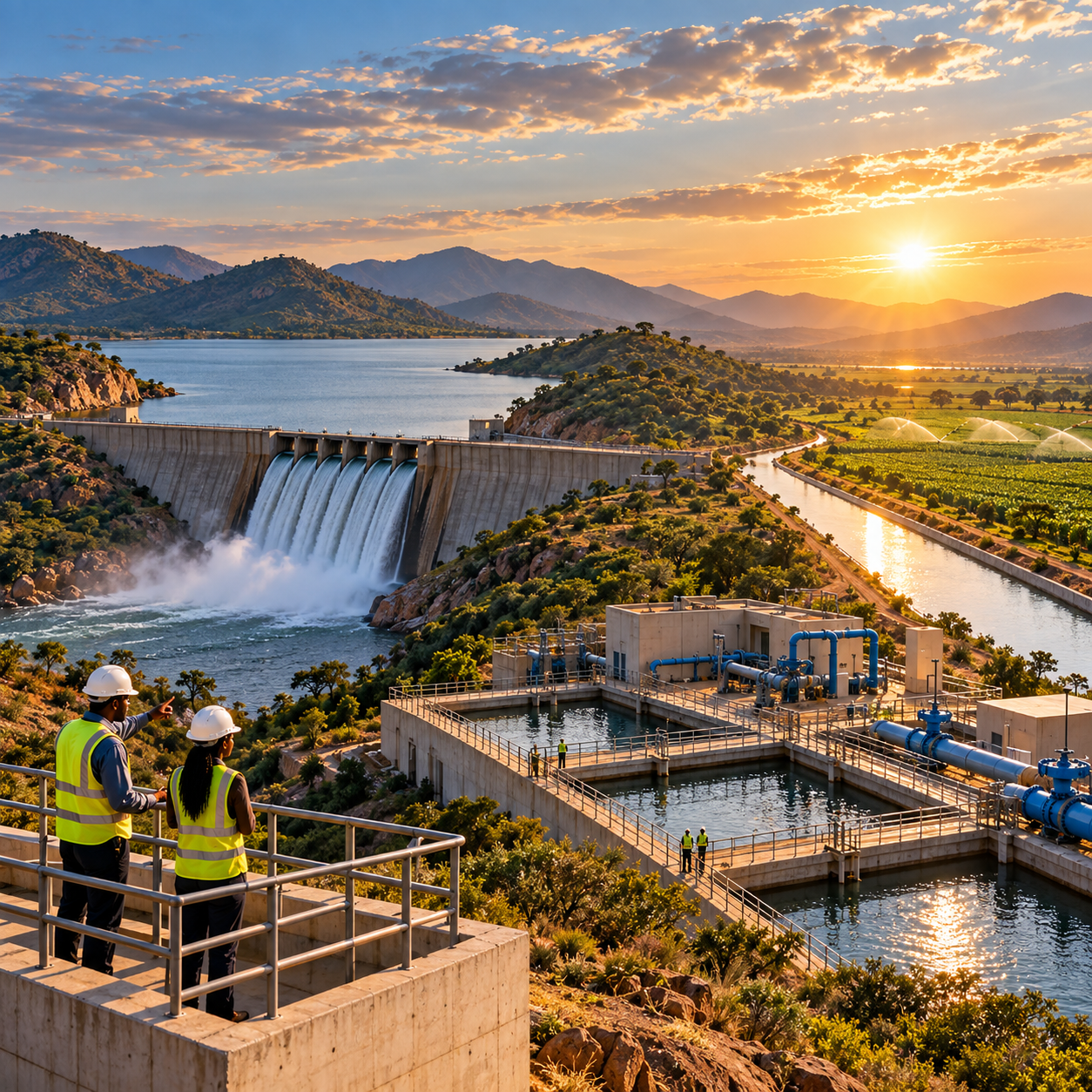
WaterW.04.01Lesotho Highlands Water Project (LHWP) Phase II
Lesotho, South AfricaSouthern Africa2020
The Lesotho Highlands Water Project (LHWP) Phase II is a multi-billion Maloti/Rand bi-national infrastructure project between the Governments of the Kingdom of Lesotho and the Republic of South Africa, established under the 1986 Treaty and the 2011 Phase II Agreement. Phase II is designed to augment water delivery to South Africa and increase hydropower generation capacity in Lesotho. The project is implemented by the Lesotho Highlands Development Authority (LHDA) on behalf of Lesotho and the Trans-Caledon Tunnel Authority (TCTA) on behalf of South Africa.
The core infrastructure components of Phase II include: (1) The Polihali Dam, a 165 m high concrete-faced rockfill (CFRD) embankment dam located downstream of the confluence of the Senqu and Khubelu Rivers in the Mokhotlong district, which will create a reservoir with a surface area of 5,053 ha and a storage capacity of 2,325 million cubic metres; (2) A 50 m high saddle dam; (3) The Polihali-Katse Transfer Tunnel, a 38.2 km long, 5 m diameter gravity tunnel connecting the Polihali reservoir to the Katse reservoir, being excavated by two Tunnel Boring Machines (TBMs) simultaneously from both ends; (4) The Oxbow Hydropower Scheme on the Malibamatso River, with an installed capacity of 80.3 MW and an average annual output of 180 GWh, currently at detailed engineering design phase with commissioning slated for 2030/31; and (5) Advance infrastructure including roads, bridges (including the 825 m long, 90 m high Senqu Bridge), high-tension power lines, telecommunications systems, accommodation and construction facilities.
Phase II will increase the current annual water supply rate from 780 million cubic metres to approximately 1,270 million cubic metres per annum, adding 490 million cubic metres per year to South Africa's Integrated Vaal River System. Water delivery is targeted for financial year 2028/2029, with reservoir inundation planned for 2027. As of late 2025, overall project completion stood at approximately 48%, with dam construction at 37% complete. The Katse TBM was launched on 15 January 2025 and the Polihali TBM arrived on site in July 2025 and began excavation in January 2026.
Central African Republic, Chad, Republic of CongoCentral Africapap1
The Ouesso-Bangui-Ndjamena road is a link in the Pointe Noire-Brazzaville / Kinshasa-Bangui-Ndjamena multimodal transport corridor. The road is also part of the network of the priority program of the consensual master plan of transport in Central Africa (PDCAT). The corridor connects the capitals of Congo, the Democratic Republic of Congo, the Central African Republic (CAR) and Chad. It also provides the CAR and Chad with a second access to the sea.
A highway network of approximately 1310 km, which starts from Ouesso in North Congo to MbaA¯koro (near Moundou) in the South of Chad while passing through Bangui in Central African Republic. It comprises the following two sections: (i) the Ouesso-Bangui section in the equatorial forest to the South, which is about 640 km long and lies across Congo and the CAR; and (ii) the Bangui-MbaA¯koro section in the savannah woodland to the North, which is about 670 km long and lies in CAR and Chad territory;
TransportT.13.04.01Dakar - Bamako Standard Gauge Railway (Senegal section)
Burkina Faso, Mali, SenegalWest Africapap1
This project covers the Senegal portion of the Dakar-Ndjamena-Djibouti Road/ Railway project. This is a multimodal transboundary transport corridor including Senegal, Mali, Burkina-Faso, Niger, Nigeria, Cameroon, Chad, Sudan, Ethiopia and Djibouti. It is a combination of the Trans-African Highway 5 (Dakar to N’djamena) and 6 (N’djamena to Djibouti), a combined distance covered of 8,715 km.
However over time, the railway transport route between Dakar and Bamako has become degraded and and created hindrances in the international services for passenger transportation. In order to improve the competitiveness of the route, the two states financed a study in order to define the best way to finance or to participate in the funding of the Dakar- Bamako railway infrastructure upgrade.
The project will have the following components:
Rehabilitation of the platform and reconstruction of the engineering works to 22.5 tons / axle;
Railway rehabilitation (main roads and service roads)
Implementation of a train cantonment system and a telecommunications system in line with UIC railway standards;
Acquisition of rolling stock and railway equipment;
Development and renovation of station facilities.
The Dakar-Bamako Rail Project has been prioritised by the Government of Senegal as the first of three phases of the Project. It entails the rehabilitation of the existing railway network between Dakar and Bamako (1,228 km), with a total project cost of US$ 2.2 billion.
TransportDar es Salaam - Chalinze - Morogoro Road Capacity Upgrade
Burundi, Rwanda, Tanzania, UgandaEast Africapap1
Rehabilitation and upgrading of the 197 km of road which would be the first toll road in Tanzania (First 100 km 6 lanes and then 4 lanes). The project requires the construction of a new road, adjacent to the existing road, that will give drivers the choice between paying for a superior toll road, constructed to expressway standards, or making use of the existing road. The project comprises four and six lane carriageways, 8 interchanges, 7 toll plazas and weigh bridges as well as a number of bridges.
Tanzania"’s Roads Act 2007 recognises the Dar es Salaam - Chalinze - Morogoro road section as part of the main TANZAM Highway and Central Corridor T-1 route which connects Dar es Salaam and its port with land locked neighbouring countries.
Cameroon, Democratic Republic of Congo, Gabon, Republic of CongoCentral Africapap1
The project includes the construction of a road and rail bridge between Brazzaville in Congo and Kinshasa in the DRC. The project also includes road and rail links in both countries as well as joint border control points (One Stop Border Posts). A border control post will be located at each end of the bridge and will house border control officers. Inspections will only be conducted on one side of the river (i.e. on the departure side). The existing road infrastructure will be extended by 10km to connect the bridge to the two cities.
The railway bridge will have a total length of 1 575m and 10 bays divided as follows: 2 bays of 120m, 4 bays of 152m, 2 bays of 242m and two bays of 121.5m. The profile on the other side of the road consists of two unidirectional sidewalks with two lanes of 3m. The total width of the road, including sidewalks, is 16.24 m.
The two large cable-stayed spans (242m and 152m), located in the river along the banks, give the bridge a gateway to the capitals. The bridge will be located in Maloukou Trechot, 6km from the city of Maluku in Congo. The site is 55km from the two capitals along the river.
The bridge is part of a larger project, the Kinshasa-Ilebo railway project, which aims to improve the rail network in Africa. The larger project is expected to contribute to increased regional trade and accelerate regional integration between Central and Southern Africa. The project is expected to allow for cheaper and faster river crossing by passengers and freight. The beneficiaries of the project will therefore include the two countries whose fisci will benefit from increased trade, the increased presence of domestic and foreign companies in both countries, from private transporters and the economic and social benefits of liberated movement of both populations
Kenya, South SudanEast Africa, North-Eastern AfricaIGAD
Construction of 365 km Juba-Torit-Kapoeta-Nadapal single cariageway road in South Sudan. The road links with the proposed South Sudan/Kenya OSBP project at Nadapal.
TransportExport coal expansion to 81mtpa (South Africa)
The project incorporates a combination of capital expenditure and operational optimisation initiatives to increase the capacity of the overall export coal system to 81mtpa. These projects include:
- Major upgrades to the power supply and overhead traction equipment
- Running line upgrades
- Matlabas loop extension
- Rolling stock yards"
TransportT.08.04.01Dar es Salaam Port Modernisation
TanzaniaEast Africapap1
The project involves the modernisation of the Dar es Salaam Port, including upgrade to berths 1 to 7, deepening of the harbour, improveing cargo handling and port layout.
TransportT.06.03.01.01Serenje - Nakonde Road Link 1 (Serenje - Mpika)
Botswana, Malawi, Namibia, Republic of Congo, Tanzania, Zambia, ZimbabweCentral Africa, East Africa, Southern Africapap1
The Serenje-Nakonde project road runs in a north eastern direction from Serenje in Zambia's Central Province to Nakonde (at the border post between Zambia and Tanzania) in the Northern Province covering a total distance of 611.5 km. The road is divided in 3 links: Link 1: Serenje to Mpika (238.3 km), Link 2: Mpika to Chinsali (164.6 k), Link 3: Chinsali to Nakonde (208.6 km) The Serenje-Nakonde road is part of the Regional Trunk Road Network (RTRN Link 15) as well as the Trans-African Highway Nr 4.
TransportT.06.03.01.03Serenje - Nakonde Road Link 3 (Chinsali - Nakonde)
Botswana, Democratic Republic of Congo, Malawi, Namibia, Tanzania, Zambia, ZimbabweCentral Africa, East Africa, Southern Africapap1
The Serenje-Nakonde project road runs in a north eastern direction from Serenje in Zambia's Central Province to Nakonde (at the border post between Zambia and Tanzania) in the Northern Province covering a total distance of 611.5 km. The road is divided in 3 links: Link 1: Serenje to Mpika (238.3 km), Link 2: Mpika to Chinsali (164.6 k), Link 3: Chinsali to Nakonde (208.6 km) The Serenje-Nakonde road is part of the Regional Trunk Road Network (RTRN Link 15) as well as the Trans-African Highway Nr 4.
TransportT.06.03.01.02Serenje - Nakonde Road Link 2 (Mpika - Chinsali)
Botswana, Democratic Republic of Congo, Malawi, Namibia, Tanzania, Zambia, ZimbabweCentral Africa, East Africa, Southern Africapap1
The Serenje-Nakonde project road runs in a north eastern direction from Serenje in Zambia's Central Province to Nakonde (at the border post between Zambia and Tanzania) in the Northern Province covering a total distance of 611.5 km. The road is divided in 3 links: Link 1: Serenje to Mpika (238.3 km), Link 2: Mpika to Chinsali (164.6m), Link 3: Chinsali to Nakonde (208.6 km) The Serenje-Nakonde road is part of the Regional Trunk Road Network (RTRN Link 15) as well as the Trans-African Highway Nr 4.
Rehabilitation of 75 km of existing Kampala-Jinja road to widen and strengthen the carriageway. The road forms a critical section of the Northern Corridor, linking landlocked East African countries with the Port of Mombasa.
ZiZaBoNa creates a new Western Transmission Corridor in Southern Africa, by linking the power systems of Zimbabwe, Zambia, Botswana and Namibia. This part of the project involves the construction of a 231 km / 330 kV transmission interconnector from Livingstone Substation (Zambia) to Zambezi Substation at Katima (Botswana), with a transmission capacity of 300 MW. Here it joins the Caprivi HVDC link.
Construct new 200W Marakele loop at between Thabazimbi & Matlabas (i.e. Km 27.400 - Km 30.700)
Construct new 200W Diepspruit loop at between Matlabas & Lephalale (i.e. Km 79.100 - Km 82.200)
Extend the existing Boshoek loop to accommodate 100W trains (i.e. between Km 132.82 - Km 135.78)
Construct a new 100W loop between Heystekrand and Kgetleng (i.e. between Km 159.55 - Km 160.95)
Two level crossings were identified in both Brits and Rustenburg for improvement or elimination.
Km 56.114 (Kruis Street, Brits) - Close level crossing
Km 57.018 (R511, Brits) - Upgrade level of protection to 6B
Km 111.328 ( Kerk Street, Rustenburg) - Close level crossing
Km 114.265 (Dr. Moroka Street, Rustenburg) - Upgrade level of protection to 6B
4 x Steel bridges have reached their fatigue life limit and therefore should be strengthened.
Crocodile River Bridge - at Km 58.300
Sterkstroom River Bridge - at Km 87.611
Hex River Bridge - at Km 108.060
Crocodile River Bridge - at Km 242.800
Construction of RESGEN’s Network Stabilisation Facilities (NSF) at Lephalale.
ZiZaBoNa creates a new Western Transmission Corridor in Southern Africa, by linking the power systems of Zimbabwe, Zambia, Botswana and Namibia. This part of the project is the first phase of the bigger ZiZaBoNa project and involves the construction of a 101 km / 330 kV transmission interconnector from Hwange Power Station to Victoria Falls Substation in Zimbabwe and construction of the 14km Victoria Falls to Livingstone cross-border link with a transmission capacity of 300 MW.
ZiZaBoNa creates a new Western Transmission Corridor in Southern Africa, by linking the power systems of Zimbabwe, Zambia, Botswana and Namibia. This part of the project involves the construction of a 76 km / 330 kV transmission interconnector from Pandamatenga Substation (Botswana) to Victoria Falls Substation (Zimbabwe), with a transmission capacity of 300 MW.
Development of the Waterberg rail system to accommodate coal and other traffic from Botswana through the Waterberg and Rustenburg regions.
The project consists of a study to consider a possible new heavy haul line between Lephalale and the Botswana rail network.
Line capacity will be 20mtpa scalable to 40mtpa in single line configuration.
This project is developmental and not purely demand driven.
The project incorporates a combination of capital expenditure and operational optimisation initiatives to increase the overall coal export system to 81mtpa.
-Major upgrades to the power supply and OHTE
-Running Line upgrades
-Matlabas loop extension
-Rolling Stock Yards
TransportDevelop a Multi Purpose Marine Manufacturing and Offshore Oil and Gas Support Facility at Berth 205
Development of a multi-purpose marine manufacturing facility that will support maritime related manufacturing activities including but not limited to larger vessels and rig repairs for the international market, shipbuilding activities, fabrication and marine engineering. The facility will be integrated with supply chain cluster businesses in the Saldanha Bay IDZ with the potential to benefit from IDZ related incentives.
TransportDevelop a new Multi Purpose Marine Manufacturing and Offshore Oil and Gas Support Facility at the vicinity of the Mossgas Quay (alternatively at the Mossgas Quay)
Development of a multi-purpose marine manufacturing facility that will support maritime related manufacturing activities including but not limited to smaller vessels and rig repairs for the international market, shipbuilding activities, fabrication and marine engineering. The facility will be integrated with supply chain cluster businesses in the Saldanha Bay IDZ with the potential to benefit from IDZ related incentives.
TransportDevelop supporting port infrastructure and install a high capacity Floating Dock at the Port of Richards Bay
Marine (dredging and berth works) and bulk landside infrastructure development undertaken by the Transnet National Ports Authority
Concession to a a Private Sector Operator to fund, supply and operate a high capacity Floating Dock at the Port of Richards Bay.
This project entails the deepening, widening and lengthening of Berths 203 to 205 at DCT. The berths will be lengthened from 914m to 1210m and deepened from -12.8m CD to -16.5mCD.
These berths would be able to handle 3 x 350m Super Post-Panamax vessels of up to 12 000TEU capacity and with drafts of 14.5m. The current berths are inadequate to meet the demands of major container lines.
Additional Capacity:
Design capacity is 2.9 m TEU"’s.
The objective of the project is to sustain current business.
This project entails reclamation of 21 ha between Pier 1
and Salisbury Island, and a long term lease of 8.6 ha of
SA Navy land. The Navy base will be consolidated onto a
more efficient footprint. The Infill option will deliver three
deep water berths. Two berths on the diagonal and one
around the corner. The terminal will be equipped with
RTGs and STS cranes.
The current strategy to increase container handling
capacity at the Port of Durban is to proceed with the Pier
1 Phase 2 Infill option after FEL-3 completion and upon
obtaining an approved EA. This option will utilise two
deep water diagonal berths ( water depth of 16,5m) and
a deepened Berth 104 with an infill area, the TNPA land
behind Berths 99/100 and the SA Navy land.
Additional Capacity:
1.7 m TEU"’s
(2.4 m TEU"’s by 2027 therefore in the 27/28 FY).
The upgrading, reconfiguration and relocation of yards and terminals within the Durban port area in order to complement the development of port capacity. Various lines and yards to be reconfigured to accommodate port developments and improve operational efficiencies.
Intermodal terminal and rail yard facilities to be upgraded or provided at:
-Pier 1 and Pier 2
-Bayhead
-Kings Rest
-Isipingo
This sub-programme aims to increase capacity on the corridor to match the forecasted demand. It involves train control (signalling) upgrading along the corridor, upgrading Rietvalleito Glencoe section to 26t axle load , construction of new rail link line connection from Cato ridge to Durban, converting the electrification from 3 kV DC to 25 kV AC, transformer replacement from Rietvalleito Booth, and improving the connectivity of the rail network with existing and proposed intermodal terminals along the corridor (including Harrismith)
Development Strategy:
Short term: 2013 -2025: 37 to 58mtpa
-Additional block splits to allow for more trains
-Increase loops to accommodate 75 Wagon Trains
-Electrical supply (3 kV DC) and transformer upgrades
Medium Term: 2025-2035: 58 to 95mtpa
-Relieving of gradients and curves
-Upgrade of Johannesburg to Newcastle section to 25kV AC
-Increase loops to allow 150 wagon trains
CHALLENGES
-This Sub-Programmeis not currently funded.
-Complementary investments required by road to service local traffic/freight.
-Clarity on role of Harrismithfreight hub -provincial. government initiative to service Free State agriculture.
-Clarity on role of Cato Ridge freight hub -provincial government initiative for a more back of port system.
STATUS QUO
-The concept (FEL -1) study is complete.
-Extensive work underway to align demand and capacity with SIP 2 requirements.
-Phase 1 has been defined and is awaiting technical validation from TFR.
-Busy revising Plans according to latest Demand Forecast.
-Programmeunfunded.
-Programmedelayed due to shift in demand
CONTACT: Gideon Coetzee
PROJECT DESCRIPTION
CORPORATE PLAN 2018/19
18/19
19/20
20/21
21/22
22/23
Total for 5 years (Rm)
DPCT TP06 -Isipingoand Kaalfontein-Expand
-
-
10
-
-
10
Total
-
-
10
-
-
10
Feb 2018
2a:DURBAN -GAUTENG (NATCOR)
EXPANSION FROM 37 TO 105mtpa
Long term:2035 -2041: 95 to 105mtpa
-Migration to CBA (in cab) train control
-Cato Ridge to Durban new bypass line and modifications to segregate PRASA from TFR services in order to free up capacity on the NATCOR
The Durban Gauteng corridor is the most significant General Freight corridor in the South African rail system. It connects the Port of Durban and the proposed DDOP (Durban Dig-out Port) to Gauteng. About 27 mtpaof 87 mtpaGF in 2014/15 was transported on this corridor, of which 8.9 mtpawere containers, (mainly import and export) via Port of Durban.
The Transnet FDM indicates tonnages up to 105 mtpaon the corridor by 2046, (30 year forecast). Containerisedtraffic will account for more than 50% of this tonnage by 2046. Demand is expected to exceed capacity on this corridor from 2026. Even with operational efficiency improvements at that stage, extra capacity is required from 2029. Capacity is firstly added by shorter headways (block splits), then by moving to 75-wagon container trains, and then by moving to 150-wagon DP container trains & 100-wagon DP GFB trains. The Gauteng Freight Ring also requires doubling of single-line sections. All sections require electrical upgrades, and bypassing of certain PRASA sections (Union-City Deep, Skansdamlink, Cato Ridge Bypass link, Rosslyn link)
Development Strategy
Supporting intermodal growthThe Sub-Programmesare:
-NATCOR
-Gauteng Rail Freight Ring
-Gauteng Hubs and Terminals
-Durban Port and Rail Terminals
TransportEstablishing a Regional Locomotive and Wagon Leasing Pool
Angola, Botswana, Democratic Republic of Congo, Malawi, Mozambique, Namibia, South Africa, Tanzania, Zambia, ZimbabweCentral Africa, East Africa, Southern Africa
This sub-programme involves doubling of the single line sections, signalling upgrade, construction of new links, reconfiguring of train staging facilities, conversion from 3kV DC to 25 kV AC and improving the connectivity of the rail network with existing and proposed intermodal terminals in Gauteng. This sub-programme aims to provide a freight corridor between Durban and Gauteng that facilitates the movement of traffic around rather than through City Deep. It also allows access to key hubs, terminals and Southern African routes and the South African ports.
Development Strategy:
Short term: 2017 -2023:
20mtpa to 40mtpa
-Pyramid to Sentrarand-Double the existing single track, 3kV DC upgrades, CTC signalling
-Donkerhoekto Pienaarspoort-new single track cord (Sentrarandto Maputo)
-Rosslyn Link -direct link to Freight ring to bypass PRASA operational area
Medium Term: 2024 -2030: 40mtpa to 88mtpa
-Sentrarandto Skansdam-Additional block signals to allow for more trains
-Skansdamto Houtheuwel-New double track, 3kV DC, CTC signalling(PRASA bypass)
-25kV conversion Pyramid South -Sentrarand
Kasconterminalwillbeupgradedto200000and300000TEUsperannumby2016and2019respectively.Bothterminalswillberetainedforthenext30yearsandwillcomplementthenewproposedsuperterminals.
Estimated Capacity created:
300 000 TEU per annum Kascon
Approval of the reduction in export capacity through the Port of Ngqurato a capital-optimised12Mtpa
Scope change:
-Scope Change Notification supported by Transnet Board in Nov. '17. Notification in principle supported by DPE during Nov. "’17 bilateral and formal Notification submitted to Shareholder Minister in Dec. '17-pending approval. Shareholder"’s Compact KPIs amended to reflect revised scope.
-DoT notified of change in scope and completion date affecting Section 79 directive.
-Rail Phase 1:(Extension of 97km of loops between Kimberley & De Aar; and Rosmeadstation)
?Original scope of work is complete and has operationally been taken over by TFR.
?Contract with the EPCM service provider ended on 15 December 2017.
?Remaining work -managed by RME comprise upgrading of 26 level crossings and construction of a pedestrian bridge at Modderrivier.
-Rail Phase 2: (Extension of crossing loops; traction power upgrade; holding yards at Mamathwaneand Grassridge; tippler yard at Coega; loco change-over at Beaconsfield)
?Conducting scope validation study in line with the capital-optimized scope of works
?Conducting preliminary engineering towards a scope validation peer review scheduled for May 2018
?Completed works information to go out on tender for two new substations at Witloop& Vlermuislaagte
-NMET (Port) (Operationalisingand commissioning limited terminal footprint in the Port of Ngqura)
?Topographical surveys and optimised concept designs completed
?Building concept designs in progress
?Environmental authorisations in place
-CDC land acquisition: Formal delegation to proceed with commercial transaction pending
-Stakeholder management: Significant escalation of resistance from local government, businesses and citizens with regards to health & safety impact of Mnore dust via the PE bulk and break-bulk export facilities
Maydon Wharf is the largest Break Bulk and Dry Bulk precinct in the Port of Durban and in the TNPA ports system. Seven of the 15 berths were constructed 60 years ago of steel sheet piles that are now heavily corroded and at high risk of structural failure. Piecemeal repairs cannot guarantee the structural integrity of the quay walls as they have deteriorated severely and reached the end of their serviceable life. Although restrictions have been placed on the operational loading of these quays to ensure short term safety, they must be replaced as soon as possible for on going sustainable operations.
The scope entails the construction of 7 combi steel pile quay walls, inclined grouted anchors with associated cope beams, quayside paving, bollards, fenders and new services. The berths will be dredged and deepened to -14.5m CD with rock scour protection.
Phase 1 of the project required the extension of Berth 12 by 12m into the harbour to align with Berths 13 -15 and to create an additional deep water berth to handle large vessels.
Phase 2 entails the reconstruction and deepening of berths 1 -4, 13 & 14.
Capacity:
This project is to sustain the current capacity
Develop a multi-product pipeline between Durban and Gauteng to expand pipeline capacity and replace the existing pipeline that has reached the end of its economic life. Initial capacity (phase 1) will be 8.7 blpawhich includes:
Installation of 162km of 16-inch pipelines and 555km of a 24-inch trunk line pipeline, three new pump-stations and two metering-stations on the trunk line and two terminals"”one in the Port of Durban (Coastal) and one at Jameson Park near Heidelberg (Inland).
Project plan:
The approved Phase 1a (Tight lining) Ability to Operate date is 30 November 2017. At this date, the project is forecasted to be operational as a multi-product pipeline operating at 1 080m?3;/h. The Coastal Terminal accumulator tanks have been separated into Phase 1b, for which a business case is currently under review.
Showcase ready! You have a previously generated AI showcase for these projects in this session.
Generate compelling, AI-crafted narratives for your projects. The AID AI Engine will create powerful headlines, impact statements, and strategic context — perfect for presentations, stakeholder meetings, and exhibitions.
Narrative Style
Progress Briefing RECOMMENDED
Answers where it is, where it stands and what has been done — read from the latest progress reports in key points
Executive Briefing
Strategic impact, investment value & regional significance
Storytelling
Vivid narratives about community impact & continental vision
Technical
Engineering achievements, specs & development milestones
Investor Narrative
ROI potential, funding gaps, risk profile & bankability assessment
Tone & Mood
Will generate for 15projects (top by investment value). Estimated time: ~2 min.


 AID Showcase