#
Project
Investment · stage
151

Bujumbura - Bugarama Road
T.08.03.06
The Bugarama- Bujumbura road is about 35 km on the RN1, and forms part of the Central Corridor.
152
Bulawayo - Gwanda Road
The road runs in a south westernly direction from Bulawayo to the Beitbridge Border Post (between Botswana and South-Africa), covering a total of 320km. See this project on an interactive…
153
Rihaid El Birdi–Om Dafug Road
T.RD.26.09
The project proposes construction of approximately 128.3 km of paved road from Rihaid El Birdi in Sudan to Om Dafug at the Central African Republic border. It would improve a…
154

Ethiopia (Gambela) - South Sudan (Malakal) Power Transmission Line - Phase 1
BIP_NELSAP_021
The Ethiopia (Gambela) - South Sudan (Malakal) Power Transmission Line - Phase 1 project is located in the transboundary corridor connecting the Gambela region in southwestern Ethiopia to Malakal in…
155
TAH2: Algiers to Lagos - Missing Road Links in Niger
T.01.02.02
156
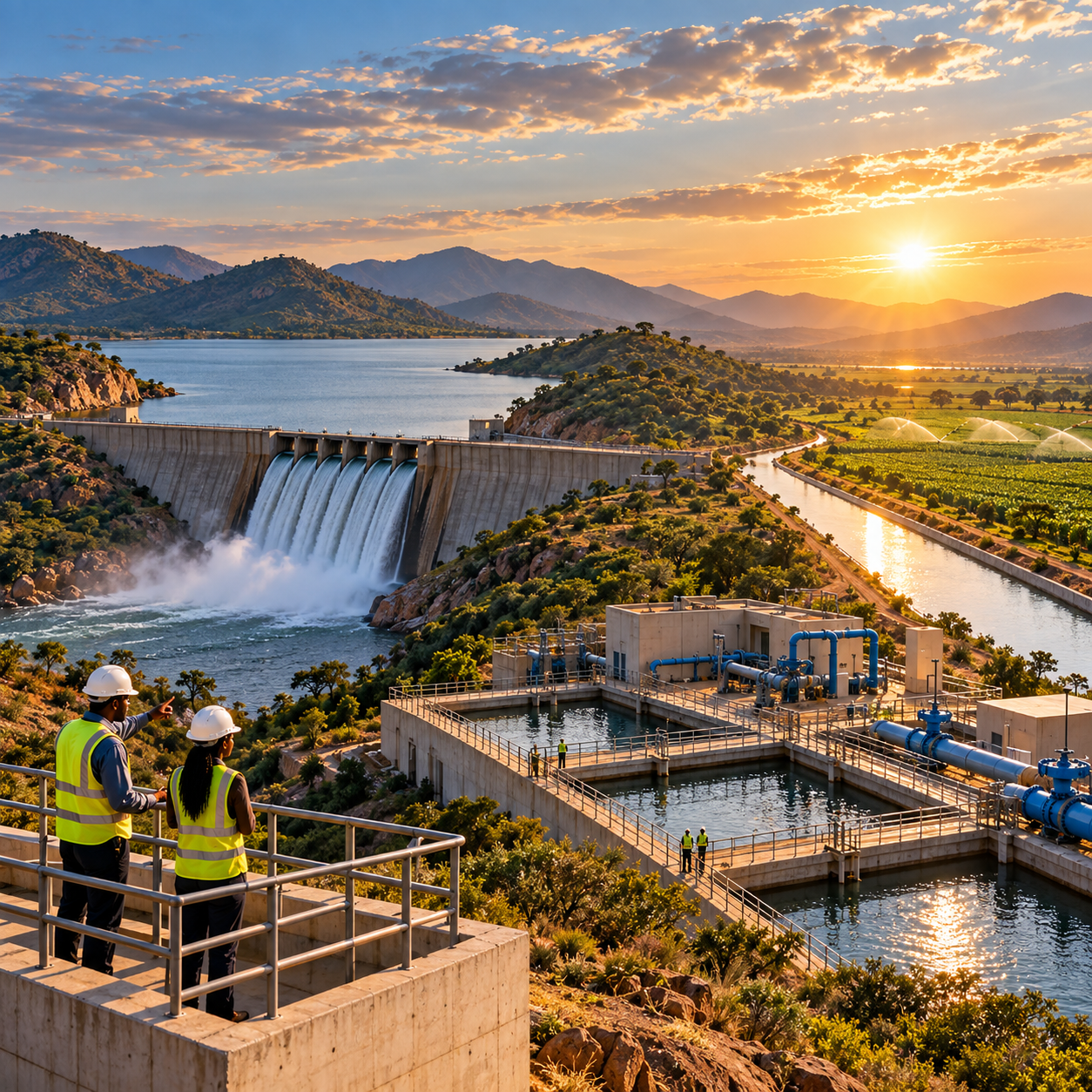
Horn of Africa Groundwater for Resilience Program II
BIP_IGAD_001
Why this Project is Needed Now?
The project is a timely intervention to strengthen the climate resilience of targeted communities in a region frequently affected by drought. By focusing on sustainable…
157
Kakono Hydropower Project
BIP_NELSAP_004
The Kakono hydropower site is located on the Kagera River, Northwest Tanzania near the border with Uganda.
As a key component of Tanzania's energy strategy, Kakono offers a strategic opportunity…
158
Integrated Management of Transboundary Water Resources of Lakes Rweru, Cyohoha and the Akanyaru Marshlands (GIRET)
BIP_NELSAP_001
The project area covers the Akanyaru marshland, the Lakes Cyohoha and Rweru and their watersheds shared by Rwanda and Burundi, and is located in the Akanyaru sub-basin and the downstream…
159
Support Programme for the Facilitation of Transport by Inland Waterways, Securing River Navigation and the Sustainable Management of Water Resources in the Congo Basin
W.30.15
The Congo Basin contains more than 25,000 km of naturally navigable waterways, including at least 15,000 km of classified routes. Managed through CICOS, the programme will improve the safety, reliability…
160
Harare - Nyamapanda Road Project
The road runs in a north-easterly direction from Harare to the Nyamanpanda Border Post (between Zimbabwe and Mozambique), covering a total distance of 278km. See this project on an interactive…
161

Development of Data Centre Infrastructures Underpinning the Digital Economy
I.02.30.04
The Development of Data Centre Infrastructures Underpinning the Digital Economy is a regional ICT programme under the Economic Community of Central African States (ECCAS). It envisions establishing six new…
162
Interconnection of Member States' Broadband Networks
I.02.30.11
Regional project under PIDA PAP 2 (2021-2030) to provide and strengthen each ECCAS Member State with high bandwidth fiber optic connectivity and establish a sub-regional data hosting centre in the…
163
Infrastructure (Energy-Hydraulic) for broad groundwater mobilization and agricultural resilience in the context of shortages and impacts of climate change in the Northern Sahara Aquifer Basin (SASS)
The Northern Sahara Aquifer System (SASS) is a basin of more than 1000,000 km shared by three countries (Algeria, Tunisia, Libya) with considerable but not renewable water potential. This water…
164
Limur / Nyimur multipurpose water resources project
BIP_NELSAP_016
The
Nyimur/Limur multipurpose water resources project is a transboundary project
located in the Aswa Basin covering parts of Lamwo District, Uganda and Magwi
Country, Eastern Equatorial State, South Sudan. The location coordinates are
3.560042°N,…
165
Beira Port Development
T-PT-26-001
The Port of Beira is Mozambique’s principal maritime gateway for the central region and an important outlet for landlocked markets in Southern Africa. It is connected by road and rail…
166
Chirundu - Harare Road Link 4 (Chinhoyi to Harare)
T.06.03.03.04
The Chirundu-Harare road runs in a south-easterly direction from Chirundu Border Post (between Zimbabwe and Zambia) to Harare, the capital city of Zimbabwe, covering a total distance of 348 km.…
167
Water Supply Project in Antanambao Manampotsy
W.30.11
The project combines water-supply infrastructure with climate-resilient water-resource management in Antanambao Manampotsy, Atsinanana Region, Madagascar. The concept includes cascading lakes and retention structures, water treatment and distribution systems, protection of…
169
Navigation on the Congo river and its tributaries the rivers Oubangui and Sangha
T.18.04
The project aims to identify all the obstacles to navigate the Congo River, and the Oubangui and Sangha tributaries as well as the port infrastructure needs in order to improve the…
170
N'djili Airport Expansion
T.22.03.03
This project is part of the expansions at 2020 gap airports Phase 1. It will see upgrades at the N'djili Airport (also known as the Kinshasa International Airport).
171
Kobero - Muyinga Road
T.08.03.03
The road is currently paved with bitumen and needs upgrading to asphalt concrete as well as carriageway expansion from 6 meter to 7 meters. The Kobero-Muyinga is on the RN6.…
172
Harare - Beitbridge Road Link 3 (Masvingo to Turn Off)
T.06.03.03.07
The road runs in a southern direction from Harare to Beitbridge Border Post (between Zimbabwe and South Africa), covering a total distance of 571km. The Harare-Beitbridge road is part of…
173
Chirundu - Harare Road Link 3 (Karoi to Chinhoyi)
T.06.03.03.03
The Chirundu-Harare road runs in a south-easterly direction from Chirundu Border Post (between Zimbabwe and Zambia) to Harare, the capital city of Zimbabwe, covering a total distance of 348 km.The…
174
Mako - Dialocoto Road
T.13.03.01
The project involves the construction of 117 km section of single carriageway road between Mako and Dialocoto. This section is of the missing links on the Dakar-Bamako road.
175
Lusahunga-Rusumo Road
T.08.03.25
Rehabilitation of 91 km of single carriageway road between Lusahunga and Rusumo in Tanzania.
176
Dinger-Bereha Irrigation and Drainage Project
BIP_ENTRO_002
Dinger Bereha Irrigation and Drainage Project is located in Chewaka Woreda develop a 7,500 ha irrigation scheme at Dinger Bereha in Chewaka Woreda. The project will abstract water from the…
177
Wad Meskin Irrigation Project
BIP_ENTRO_023
Wad Meskin barrage across Rahad River has been planned to regulate the flood flows during rainy season, for Dinder and Rahad rivers so as to satisfy the needs of Rahad…
178
Chirundu - Harare Road Link 2 (Makuti to Karoi)
T.06.03.03.02
The Chirundu-Harare road runs in a south-easterly direction from Chirundu Border Post (between Zimbabwe and Zambia) to Harare, the capital city of Zimbabwe, covering a total distance of 348 km.…
179
Kampala-Jinja Road
T.05.03.20
Rehabilitation of 75 km of existing Kampala-Jinja road to widen and strengthen the carriageway. The road forms a critical section of the Northern Corridor, linking landlocked East African countries with the Port of…
180
Taba-Gakomeye Multipurpose Water Resources Development Project
BIP_NELSAP_020
The Taba-Gakomeye Multipurpose Water Resources Development Project is a planned infrastructure project in the Nile Equatorial Lakes Region, specifically in Burundi. Its primary purpose is to develop a multi-purpose reservoir…
181
Angololo Multipurpose Water Resources Transboundary Project
Angololo Water Resources
Development Project (AWDP) is located on the transboundary Malaba River shared
by Kenya and Uganda and falls within the Sio-Malaba Malakisi (SMM) River Basin
of the Nile Basin. The project…
182
Gwanda - Beitbridge Road
The proposed project road is one of the six (6) international trunk routes connecting Zimbabwe with the neighbouring countries of Botswana and South Africa Overall, it is intended that the proposed…
183
The Ethiopia-Sudan Transmission Interconnection Project
The power system interconnection project involved the construction of a high voltage transmission line from Ethiopia to Sudan to utilise surplus hydropower from Ethiopia to replace oil-based thermal generation in…
184
Chirundu - Harare Road Link 1 (Chirundu Border Post - Makuti - Hells Gate)
T.06.03.03.01
The Chirundu - Harare road runs in a south-easterly direction from Chirundu Border Post (between Zimbabwe and Zambia) to Harare, the capital city of Zimbabwe, covering a total distance of…
185
Freetown-Monrovia-Abidjan Fibre-optic Link (Liberia section)
I.02.18.02
The Government of Liberia"’s development goals for ICT and Telecommunications are to modernize networks and create added value through the effective utilization of ICTs that make use of different technology…
186
Beira Port Dredging
T.11.05
Dredging of the 40 km entrance channel to the port of Beira.
187
Karazi Multipurpose Water Resources Development Project
BIP_NELSAP_013
188
Algeria - Tunisia section of ELTAM Transmission Interconnector (Tunisia part)
E.09.01.02
This project forms part of the ELTAM transmission interconnector which connects the power markets of Egypt, Libya, Tunisia, Algeria and Mali. In particular, it involves the reinforcement of the Tunisia…
189
Bachuma Gate – Maji ya Chumvi Road.
T.05.03.07
Upgrading of 53 km of road to dual carriageway from Bachuma Gate to Maji ya Chumvi (Kenya).
190
Tabora-Nyahua Road
T.08.03.19
Upgrading of 85 km of single carriageway road from Tabora to Nyahua in Tanzania.
191
Extension of National ICT Broadband Backbone (NICTBB) to DRC by construction of optical fibre cable across Lake Tanganyika and point of presences (PoPs) for providing connectivity with DRC
I.02.30.10
The project involves the construction of a submarine optical fiber cable across Lake Tanganyika, connecting Kigoma in Tanzania to Kalemie in the Democratic Republic of the Congo (DRC). The cable…
192
Mombasa Port New Petroleum Facility
T.05.06.02
The project is designed to meet the need for additional liquid bulk capacity through design of a BOT project for a single buoy point or off shore jetty system.
193
Praia-Dakar Shipping and Maritime Services Project
T.IW.26.01
The project is intended to establish a reliable maritime connection of more than 660 km between Praia and Dakar, with potential interfaces to other West African ports through the Praia-Dakar-Abidjan…
194
Fomi Multipurpose Dam Development Project
W.30.10
The Fomi project is a multipurpose dam proposed on the Niandan River in Guinea within the Upper Niger Basin. The approved project concept includes a reservoir of about 4,978 million…
195
Sudan Section of the Fiber Optic Connectivity Component of the Port Sudan to Douala Corridor
I.02.30.09
High-quality ducted fiber corridor linking Port Sudan undersea cable landings to inland Central African states, supporting broadband connectivity to Chad, Central African Republic, Ethiopia, and South Sudan. The corridor positions…
196
ZiZaBoNa Transmission Interconnector (Livingstone - Katima Mulilo section)
E.02.07.02
ZiZaBoNa creates a new Western Transmission Corridor in Southern Africa, by linking the power systems of Zimbabwe, Zambia, Botswana and Namibia. This part of the project involves the construction of…
197
Waterberg upgrade Stage 2 - 3
Construct new 200W Marakele loop at between Thabazimbi & Matlabas (i.e. Km 27.400 - Km 30.700)
Construct new 200W Diepspruit loop at between Matlabas & Lephalale (i.e. Km 79.100…
198
Nyakarara - Mwaro - Mweya -Gitega (RN18) Road Upgrade
T.08.03.01
RN18 is a 56km road on the Central Corridor along the RN7- RN18- RN16 route and is a conduit for movement of traffic from Tanzania to Gitega and Bujumbura. RN18…
199
ZTK Transmission Interconnector (Kenya section)
E.02.03.02
Construction of a transmission line that connects the power networks of Zambia, Tanzania and Kenya. This project includes the 96km Kenyan section of the 2,800km ZTK interconnector, which runs from…
 AID Showcase